 How-to
How to Spot the Signs of Hidden Mold Growth
Last Updated: November 8, 2026
Quick Summary
A musty or earthy smell is the single most reliable early warning sign of hidden mold growth, often detected before any visible growth appears. Other clues include dark spots or streaks on walls and ceilings, peeling wallpaper, warped wood, and a damp feeling in one room. Because mold needs moisture to grow, these signs almost always trace back to a water problem.
- Mold usually grows behind drywall, under flooring, or inside insulation for weeks or months before it becomes visible.
- Symptoms that ease when you leave the house and return when you come back point to an indoor mold problem.
- Shine a flashlight at a low angle across walls to catch texture changes and faint staining.
- A hygrometer tells you whether a room stays above roughly 50 to 60 percent relative humidity, where mold growth becomes likely.
- Don't sand, scrub, or rip out materials to check for mold, since this spreads spores.
Table of Contents
- Early Signs of Mold in House: What You Notice First
- Mold Exposure Symptoms: What Your Body May Be Telling You
- How to Detect Mold Inside Walls and Other Hidden Spaces
- Moisture Clues: Leaks, Condensation, and Water Damage
- How to Tell Mold Clues From Look-Alikes
- Safe Inspection Boundaries: When Not to Disturb Materials
- How to Get Rid of Hidden Mold in House
- Schedule a Professional Mold Inspection
- Frequently Asked Questions
Early Signs of Mold in House: What You Notice First
Most hidden mold problems announce themselves before you see a speck.
Hidden mold grows where you don't look, behind drywall, under flooring, inside insulation. By the time it's visible, it has usually been growing for weeks or months.
- A musty or earthy smell that won't go away
- Dark spots, streaks, or discolored patches on walls and ceilings
- Peeling wallpaper or bubbling paint
The U.S. Environmental Protection Agency's mold guidance notes that mold needs moisture to grow, which is why these clues almost always trace back to a water problem.
Musty, Earthy, or Damp Smells
A musty odor is the single most reliable early warning sign of hidden mold growth. That earthy, damp smell comes from mold spores and the compounds they release as they break down building materials.
Your nose detects this before your eyes can. If one closet, bathroom, or basement corner smells different from the rest of the house, treat it as a clue.
Discolored Patches, Dark Spots, and Streaks
Visible mold rarely looks like the fuzzy green stuff on old bread. On walls and ceilings, it often shows up as:
- Small dark spots clustered near corners or baseboards
- Brown or gray streaks running down from a ceiling edge
- Discolored patches that keep coming back after cleaning
Streaks usually mean water is running or dripping from above. Spots near the floor usually point to moisture wicking up from below. Where the mark sits tells you where to look for the leak.
Mold Exposure Symptoms: What Your Body May Be Telling You
Mold exposure symptoms often look like everyday allergies, which is exactly why people miss them.
The CDC's information on mold and health explains that mold can cause allergic reactions and respiratory irritation, especially in people with asthma or sensitivities.
One pattern matters more than any single symptom: symptoms that ease when you leave the house and return when you come back.
Symptoms alone can't confirm mold. Use symptoms as one piece of evidence, then verify with an inspection.
Why Symptoms Often Get Worse at Home
Symptoms that flare up indoors usually point to something in the indoor air: mold spores, damp air, and poor ventilation concentrate in closed-up spaces.
- Symptoms improve after a few hours away from home
- They return within an hour or two of coming back
- One room triggers more irritation than others
Better airflow reduces airborne spores, which is why ventilation matters so much in mold prevention. If opening a window fixes your cough, that room's air is worth investigating.
How to Detect Mold Inside Walls and Other Hidden Spaces
To detect mold inside walls, look past the surface and follow the moisture.
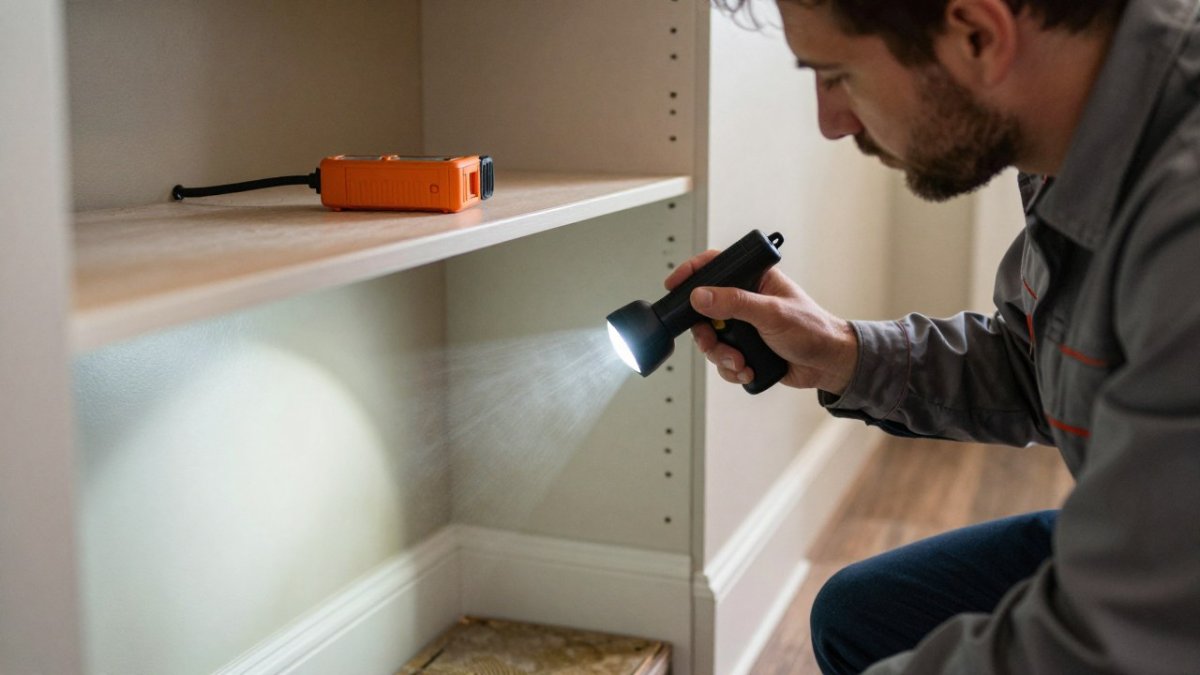
Start with your senses, then confirm with tools. Shine a flashlight at a low angle across walls to catch texture changes and faint staining.
If you suspect mold is already spreading behind a wall, our guide on how to handle mold in walls walks through the full process step by step.
A Room-by-Room Inspection Checklist
Work through your home in a set order so nothing gets missed:
- Bathroom: check caulk lines, the base of the toilet, under the sink, and the ceiling below the upstairs bath
- Kitchen: pull the fridge out, check under the sink, and look behind the dishwasher
- Basement: inspect the bottom of walls, floor joists, and any stored boxes or furniture against concrete
Write down what you find and where. That record helps if you file an insurance claim or hire a pro.
Moisture Clues: Leaks, Condensation, and Water Damage
Every mold problem starts with moisture, and most moisture problems leave a trail. The difference between finding hidden mold early and finding it after a wall is opened is usually not a better eye, it is a better method for tracing where the water comes from.
Burst clues (a leak or event):
- Wet spots or rings on ceilings and walls
- Warped wood, swollen baseboards, or soft drywall
- Loose or lifted floor tiles
Continuous clues (ongoing humidity or slow seepage):
- Condensation on windows, pipes, or cold walls
- A damp feeling in one room that others don't have
- Paint that bubbles or wallpaper that peels near exterior walls
Tracing the Source Instead of Just Spotting the Stain
A stain tells you where water ended up, not where it started. Water moves down and along framing, so a ceiling stain near an interior wall often originates at a roof penetration, a second-floor bathroom, or an HVAC condensate line above that spot, not directly overhead.
Use these steps to trace a source:
- Map the stain's shape. A round ring usually means a slow drip that pooled and dried. A streak means water ran along a path. A cluster of small spots means repeated condensation or splashing.
- Check the room above and the space behind. Look at the floor above the stain, the attic or crawlspace, and any plumbing chase or ductwork nearby.
- Test with a moisture meter. Press the pins or pad against the stain and against a known-dry area a few feet away. A reading clearly higher than the dry reference means the material is still wet, even if the surface feels dry.
- Recheck after drying. Wipe condensation dry, run a fan, and check again in 24 hours. Moisture that returns without a new leak points to humidity or a cold-surface problem rather than a plumbing failure.
- Follow the humidity. A hygrometer costs little and tells you whether a room stays above roughly 50 to 60 percent relative humidity, the range where mold growth becomes likely on damp materials. If one room reads consistently higher than the rest of the house, that room has a ventilation or moisture-source problem.
Condensation: The Quiet Culprit
Condensation builds up on cold surfaces in bathrooms, on winter windows, and on pipes in humid spaces.
Wiping condensation away without fixing the cold surface or the humidity source only resets the clock. The moisture will return, and mold will follow.
Once you spot water damage, speed matters. Our guide on how to mitigate water damage before mold sets in covers the first steps to take.
How to Tell Mold Clues From Look-Alikes
Not every dark spot is mold, and treating every stain like a crisis wastes time and money. Knowing the difference saves you a panic call.
| Clue | Often Mold | Often a Look-Alike | How to Tell |
|---|---|---|---|
| Dark spots on walls | Clustered, spreading, musty smell | Mildew from poor airflow | Mildew stays on the surface and wipes away easily |
| Streaks on ceiling | Water-carried growth, follows a leak path | Water stains from an old, fixed leak | Stains that stay dry and stop spreading are usually old |
| Discolored grout | Black or green growth in damp grout | Dirt, soap scum, or hard water film | Mold returns fast after cleaning; dirt takes longer |
| Warped wood | Swelling from ongoing moisture | Damage from a past, resolved leak | A moisture meter shows whether the wood is still wet |
| Musty smell | Active hidden mold growth | Stale air, old carpet, or poor ventilation | Air out the room; a smell that returns points to mold |
Safe Inspection Boundaries: When Not to Disturb Materials
Some spots should not be touched. Disturbing mold growth can send a cloud of spores into the air and spread the problem to rooms that were clean.
Stop and call a professional if you see:
- Mold covering an area larger than roughly a few square feet
- Growth on HVAC ductwork or inside the air handler
- Mold behind wallpaper or paneling that would need tearing out
Don't sand, scrub, or rip out materials to "see how bad it is." Don't run a fan in a moldy room. Don't dry-brush visible growth.
Poking at soft drywall to check for mold can release spores and turn a contained problem into a whole-room one.
How to Get Rid of Hidden Mold in House
Knowing how to get rid of hidden mold in house starts with one rule: fix the moisture first. Remove the mold and leave the water source, and it comes right back.
Here's the order that works:
- Stop the water. Fix the leak, dry the space, and correct the ventilation problem.
- Dry the area fully. Fans and dehumidifiers dry building materials before mold can regrow.
- Remove affected materials. Porous items like drywall, insulation, and carpet usually can't be saved once mold is in them.
- Clean hard surfaces. Non-porous materials can be cleaned and dried.
- Verify the fix. Confirm moisture readings are back to normal before closing anything up.
Larger areas, HVAC contamination, or any growth inside walls call for professional mold remediation.
For a full-service option, you can book disaster restoration with a team that handles water, mold, and structural repair under one roof.
Schedule a Professional Mold Inspection
A professional mold inspection answers the question your nose can't: is there hidden mold, where is it, and how far has it spread? A professional inspection can use moisture meters, thermal imaging, and air sampling to find growth behind walls. But know what an inspection can and cannot establish before you book one.
What a Professional Inspection Typically Covers
A professional inspection may include the following steps:
- A walkthrough with moisture readings compared against dry reference areas
- Thermal imaging to spot temperature differences that suggest trapped moisture behind surfaces
- A visual check of likely hiding places, under sinks, behind appliances, in the attic, along exterior walls, and around HVAC equipment
A good inspector will tell you where the moisture is coming from, not just where the mold is. If the report only says "mold present" without identifying a moisture source, it is incomplete.
Mold Testing: When It Is Useful and What It Can Establish
Mold testing is often misunderstood.
Testing is most useful in a few situations:
- Confirming a suspected source when growth is not visible
- Checking that remediation worked before a space is reoccupied or a project is closed out
- Documenting conditions for an insurance claim or a real estate transaction
Testing is least useful when you already have visible growth and an obvious moisture source. The moisture problem matters more than the test result, and the money is usually better spent fixing the water and removing the growth.
Watch out: a test result without a moisture investigation can create false confidence. A "normal" air sample does not prove a wall cavity is dry, and an elevated sample does not tell you where the growth is.
When to Call a Professional Instead of Continuing DIY
Bring in a qualified professional if any of the following apply:
- Growth covers an area larger than roughly a few square feet
- Mold is on HVAC ductwork or inside the air handler
- Growth is behind wallpaper, paneling, or inside a wall cavity
Before you hire anyone, verify their credentials. Our guide on how to verify restoration contractor credentials lists what to check, and our walkthrough on how to choose a restoration contractor covers the vetting steps in detail.
At Mint Restoration, our technicians are IICRC, RIA, and ASCR certified, and we're a fully licensed, insured, and bonded general contractor.
That faint musty smell in the hallway is worth taking seriously. Hidden mold growth gets worse with time, and the sooner you find the moisture source, the smaller the repair.
Frequently Asked Questions
What are the first signs of mold in a house?
The earliest clues are usually a musty or earthy smell, discolored patches or streaks on walls and ceilings, and moisture problems such as leaks, condensation, or warped wood. Peeling wallpaper and bubbling paint are also common. Because hidden mold often grows behind drywall or above ceiling tiles, you may notice the smell before you see anything. If symptoms like sneezing or eye irritation get worse at home, that is another reason to inspect.
Can hidden mold cause health symptoms?
Mold exposure can trigger allergic reactions and respiratory irritation in some people, including a runny nose, nasal congestion, sneezing, coughing, sore throat, and eye irritation. Symptoms that improve when you leave the building and return when you come back are a pattern worth documenting. Symptom-based identification is not proof of mold, though. A professional inspection is the reliable way to confirm hidden mold growth and find the moisture source feeding it.
How do I get rid of hidden mold in a house?
Start by finding and fixing the moisture source, because mold returns if the water intrusion continues. Small areas on hard surfaces can sometimes be cleaned, but mold behind walls, under flooring, or inside an HVAC system usually needs professional remediation. Do not tear into suspect materials without containment, since disturbing mold can spread spores. A licensed restoration contractor can trace the source, remove affected materials safely, and dry the structure.
Is a small amount of mold in a home safe?
There is no single accepted threshold for safe mold levels, and reactions vary by person. Some people are unaffected by small amounts, while others with allergies or respiratory conditions react quickly. The bigger issue is what the mold indicates: an active moisture problem that will keep feeding growth. Even a small patch on a wall or ceiling warrants finding the water source. If the area is larger than a few square feet or keeps returning, get a professional inspection.